
When Collaboration Takes Root: A Greenhouse Partnership Strengthening Workforce Development in Kentucky

Updated: Jul 28
When winter ice damaged greenhouse structures at Kentucky State University, it seemed like a setback. Instead, the damage sparked an unusual collaboration that is expanding hands-on training and workforce development opportunities in controlled-environment agriculture across Kentucky.
The partnership emerged through DARE-KY (Driving Agriculture Research and Education in Kentucky), a National Science Foundation EPSCoR E-RISE project led by Kentucky State that focuses on advancing soilless agriculture research, technology development and workforce training.
Through DARE-KY, institutions across the state, including Bluegrass Community and Technical College (BCTC), University of Pikeville, FoodChain and the Kentucky Science and Technology Corporation are working together to expand research capacity while preparing students for careers in emerging agriculture technologies.
Kentucky was the first state in the nation awarded all three National Science Foundation EPSCoR tracks: Track 1 (CLIMBS), E-CORE (CAPTIVATE KY) and E-RISE (DARE-KY). Within this broader network, DARE-KY focuses specifically on controlled environment agriculture and workforce development.
How the Greenhouse Transfer Took Shape
Under DARE-KY, that collaboration recently led to a move rarely seen in higher education research settings: the transfer of a greenhouse structure from Kentucky State University to BCTC.

Resource sharing works when it is intentional. When institutions communicate clearly and focus on shared outcomes, everyone benefits, especially the students. - Galen McCarty, Greenhouse Operations Manager, Bluegrass Community & Technical College (BCTC)
The greenhouse transfer emerged from a combination of rising construction costs and an opportunity to repurpose existing infrastructure.
According to Leo Fleckenstein, senior research associate at Kentucky State and senior personnel on the DARE-KY initiative, both institutions were experiencing increased costs associated with greenhouse construction, particularly for steel-framed structures. At the same time, the University experienced significant winter ice damage at its organic agriculture research facility. Several high tunnels, which are unheated greenhouse-style structures used for season extension, collapsed under the weight of accumulated ice and snow.
While three structures were beyond repair, one hoop house frame, a type of steel-supported high tunnel, remained structurally sound despite requiring refurbishment. Kentucky State had planned to dismantle the structure to make space for new grant-funded construction. Instead, project leaders explored whether the frame could be donated to BCTC to help preserve the scale and intent of workforce development goals outlined in the DARE-KY grant.
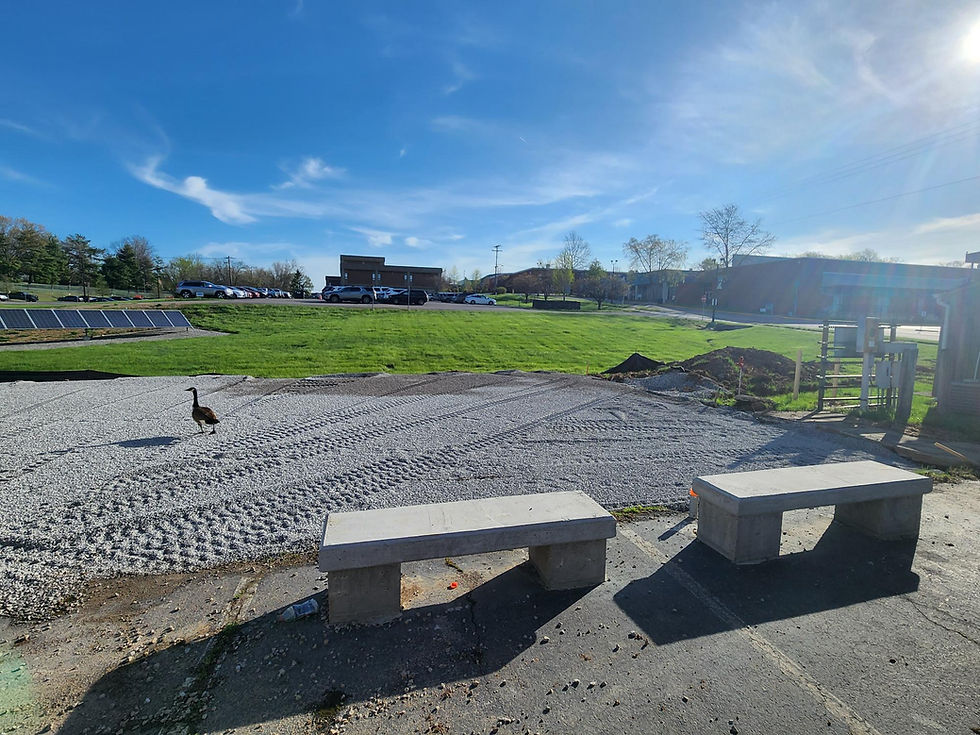
The process required consultation with faculty, review through the grant office, administrative approval and authorization from the university’s Board of Regents. BCTC also completed its own internal review before receiving the donation.
It took some time. There were steps, but it is definitely doable. - Leo Fleckenstein, Senior Research Associate and Personnel, Kentucky State and DARE-KY
Rather than discarding usable infrastructure, the institutions aligned around a shared goal of maximizing opportunities for Kentucky students.
A Rare Example of Resource Sharing
Both institutions emphasized that transferring research infrastructure between universities is uncommon.
In my experience, it is a relatively unique approach. Repurposing research infrastructure in a way that directly supports teaching and workforce training is not something you see every day. - Galen McCarty, Greenhouse Operations Manager, Bluegrass Community & Technical College (BCTC)
Fleckenstein emphasized that the effort reflects careful stewardship of public funding and a commitment to maximizing available resources.
At the end of the day, we want to be good stewards of the money we receive and maximize the use of it as much as possible. If there is a way to continue the use of something, then that should be pursued. - Leo Fleckenstein, Senior Research Associate and Personnel, Kentucky State and DARE-KY
Collaborations of this scale require significant coordination.
“There is a lot of cross-communication that has to happen, a lot of paperwork and coordination that needs to go on for something like this to happen successfully,” McCarty said.
Despite the administrative complexity, both leaders agreed that shared goals and consistent communication made the transfer possible.
Hands-On Collaboration Under DARE-KY
Kentucky State serves as the primary awardee of DARE-KY, with partner institutions participating collaboratively in the project. Through this partnership, BCTC has worked closely with the University to expand its applied agriculture training capacity.
The greenhouse was gifted to BCTC’s Leestown Campus, where it will serve as a living laboratory supporting biotechnology, environmental science, aquaponics and controlled environment agriculture programs.
Our involvement is very hands on. We are responsible for operating and integrating the greenhouse into public demonstration and applied learning. We design curriculum, try to engage students and faculty and we will be maintaining the facility as a functional teaching and demonstration space. - Galen McCarty, Greenhouse Operations Manager, Bluegrass Community & Technical College (BCTC)
McCarty noted that collaboration with Kentucky State has also included knowledge sharing and technical guidance to ensure the greenhouse is effectively integrated into instruction and workforce training programs.
The partnership is now in its second year, and both institutions describe the collaboration as continuing to strengthen as planning and implementation move forward.
Expanding Workforce Development Capacity
One of the primary objectives of DARE-KY is to expand research and workforce development capacity across participating institutions. The greenhouse transfer directly supports that objective.
At BCTC, the facility will provide students with hands-on experience in soilless agriculture systems and commercial-scale production environments. Rather than working only with small classroom models, students will train in a setting that more closely reflects industry conditions.
If they are going to go work in a commercial setting, we want them to be able to get as close experience to that as possible before they join the workforce. - Leo Fleckenstein, Senior Research Associate and Personnel, Kentucky State and DARE-KY
McCarty emphasized that the greenhouse strengthens existing biotechnology and environmental science programs at BCTC.
This just opens the door to more real applied learning. Faculty and students gain a living lab that supports instruction. This is going to be huge. - Galen McCarty, Greenhouse Operations Manager, Bluegrass Community & Technical College (BCTC)
Faculty will also have opportunities to develop new curriculum centered on controlled environment agriculture and potentially expand future research engagement.
A Model for What's Possible

The greenhouse at BCTC’s Leestown Campus represents more than a transfer of materials. It demonstrates how institutions across Kentucky can work together to expand opportunities, foster hands-on learning and strengthen workforce preparation under the NSF EPSCoR framework.
The project highlights what is possible when Kentucky institutions work together with a shared purpose. - Galen McCarty, Greenhouse Operations Manager, Bluegrass Community & Technical College (BCTC)
Together, these initiatives strengthen Kentucky's capacity in climate prediction and advanced agriculture systems through coordinated collaboration among institutions statewide.
The Kentucky Science and Engineering Foundation, an initiative of the Kentucky Science and Technology Corporation, supports these efforts by partnering with researchers and institutions across the commonwealth to build capacity, advance innovation and better prepare Kentuckians for climate-related challenges through leadership of the CAPTIVATE KY initiative, partnership in DARE-KY and ongoing collaboration across Kentucky’s NSF EPSCoR portfolio.


